Throughout the smart home lab a wide range of sensors are used to monitor the environment and activities taking place. The core principle behind the choice of sensors are non-intrusive, privacy preserving and simple to retrofit into anyone’s home. Most of the devices are non-contact and require no interaction from the user, removing much of the need to rely on wearable sensors. The power of the smart home then lies in how this sensor data is combined to gain insights about what activities are taking place and changes over time.
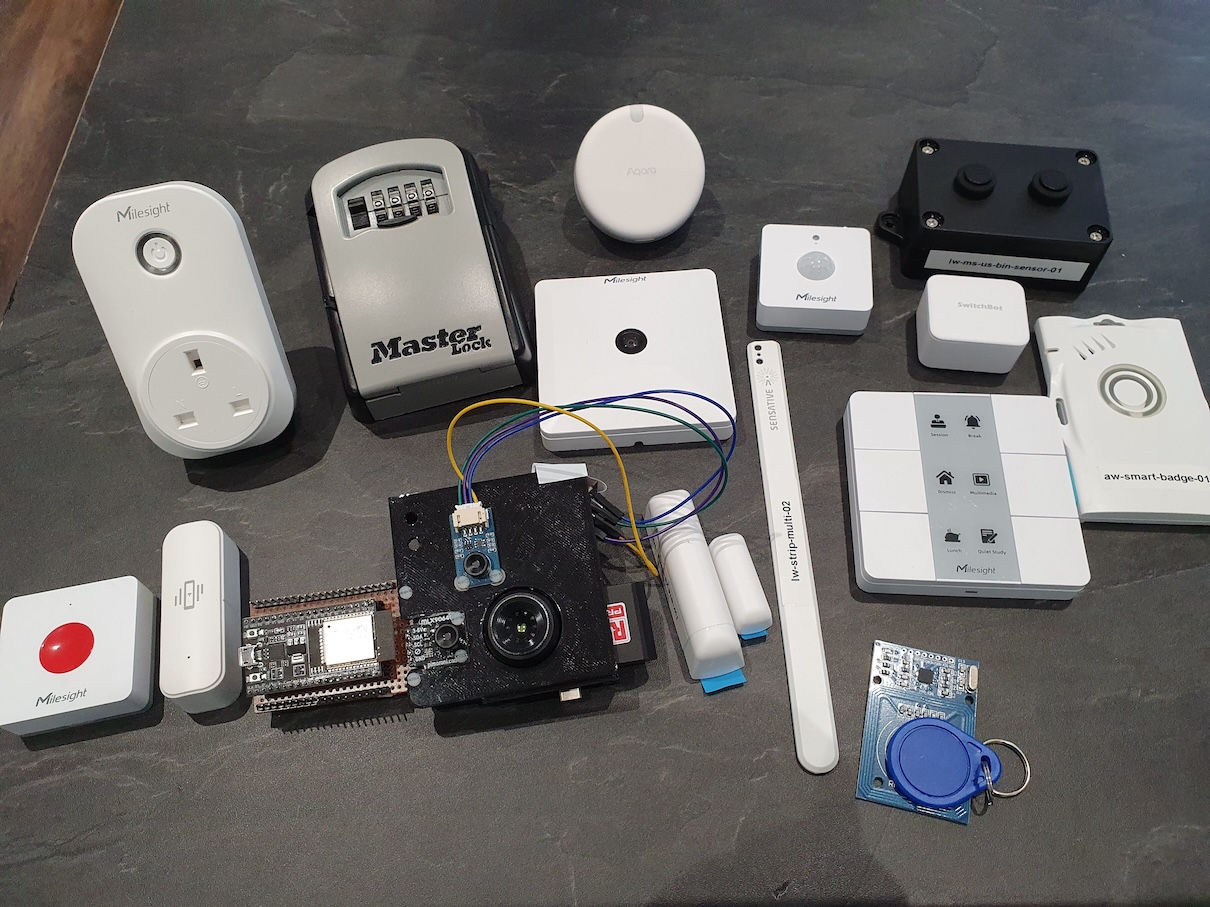
A small example of various sensors installed around the smart home lab.
Types of sensors
Environmental sensors
Ambient monitoring of the environment such as temperature, relative humidity, air quality and light levels.
Safety sensors
Monitoring for leaks, fires, break-ins, water temperature and flow.
Activity sensors
Ranging from door contact sensors to different kind of motion sensing. Pressure sensors, power usage on appliances, sound level. Careful placement of these sensors around the home allows different types of activities to be distinguished, and tracking of activities of daily living.
Interaction
Whilst most sensors are passively monitoring, some seek direct interaction from the occupant, tracking mood, triggering automations, requesting help, taking biometric measurements such as heart rate.
How our sensors communicate
Most of the sensors around the smart home lab are wireless and low-powered battery operated.
Wifi
Communicating directly through a home router typically with an app.
Bluetooth
Using a bluetooth hub to provide low power communication to various devices over relatively short range.
Zigbee
Using a hub or router, zigbee offers low power communication and forms a mesh network between devices allowing the range to be extended around the home.
LoRaWAN
Long Range (low powered) Wide Area Network, these devices do not rely on the home router or Internet connection but can instead communicate with a gateway potentially up to 10km away.